Saturday, January 5, 2013

100 Billion Alien Planets


Data from NASA's Kepler mission finds evidence for at least 100 billion planets in our galaxy. Image released January 3, 2013.
Credit: NASA/JPL-Caltech

'Snake River' Rock Feature Viewed by Curiosity Mars Rover


The sinuous rock feature in the lower center of this mosaic of images recorded by the NASA Mars rover Curiosity is called "Snake River." The images in the mosaic were taken by Curiosity's Navigation Camera during the 133rd Martian day, or sol, of the rover's mission on Mars (Dec. 20, 2012).

On Sol 147 (Jan. 3, 2013), Curiosity drove about 10 feet (3 meters) to get a closer look at Snake River for before proceeding to other nearby rocks.


Image Credit: NASA/JPL-Caltech

Friday, January 4, 2013

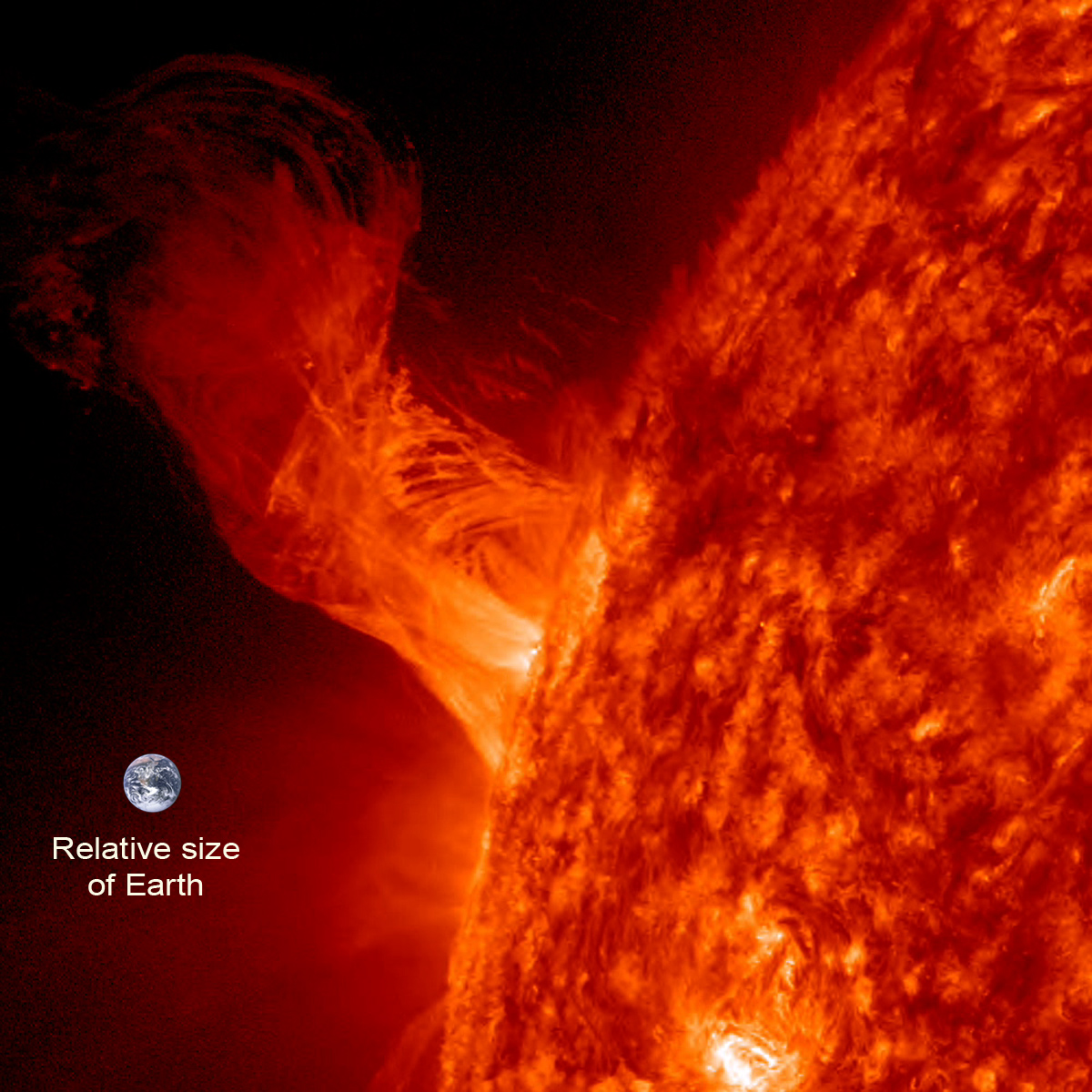
Solar Ballet on the Sun


The Earth is superimposed on this image to give readers a sense of the scale. The length of the eruption extends about 160,000 miles out from the Sun. With Earth about 7,900 miles in diameter, this relatively minor eruption is about 20 times the diameter of our planet. Credit: NASA/SDO/Steele Hill

Researchers Identify Water Rich Meteorite Linked To Mars Crust

Designated Northwest Africa (NWA) 7034, and nicknamed "Black Beauty," the Martian meteorite weighs approximately 11 ounces (320 grams). Credit: NASA 

NASA-funded researchers analyzing a small meteorite that may be the first discovered from the Martian surface or crust have found it contains 10 times more water than other Martian meteorites from unknown origins.

Answer To Question 163

A163: The Moon is the only natural satellite of the Earth,and the fifth largest satellite in the Solar System. It is the largest natural satellite of a planet in the Solar System relative to the size of its primary,having 27% the diameter and 60% the density of Earth, resulting in 1⁄81 its mass. The Moon is the second densest satellite after Io, a satellite of Jupiter.

Thursday, January 3, 2013

What is a Moon?


Q163: Question of the Day - 03 January 2013 (Week 01)

What is a Moon?

Answer To Question 162

A162: the celestial sphere is an imaginary sphere of arbitrarily large radius, concentric with the observer. All objects in the observer's sky can be thought of as projected upon the inside surface of the celestial sphere, as if it were the underside of a dome or a hemispherical screen. The celestial sphere is a practical tool for spherical astronomy, allowing observers to plot positions of objects in the sky when their distances are unknown or unimportant.

Fishing for Findings in Space Station Bone Health Study


The Medaka Osteoclast investigation takes place inside the Aquatic Habitat aboard the International Space Station. The grid structure at the upper side of each Aquatic Habitat aquarium holds air, while preventing water from escaping. The air is injected with special syringe by the crew.

(JAXA)

Hubble Eyes a Wanderer Dancing the Dance of Stars and Space

The NASA/ESA Hubble Space Telescope provides us this week with a spectacular image of the bright star-forming ring that surrounds the heart of the barred spiral galaxy NGC 1097. In this image, the larger-scale structure of the galaxy is barely visible: its comparatively dim spiral arms, which surround its heart in a loose embrace, reach out beyond the edges of this frame.

Quadrantids Create Year's First Meteor Shower

Tonight (Jan. 2-3) is the peak of the 2013 Quadrantid meteor shower. Best viewing will be in the northern hemisphere, but the shower can be seen at latitudes north of 51 degrees south. Meteor rates increase after midnight and peak between 3 a.m. and dawn, your local time at whatever location you're viewing the shower. To view Quadrantids, go outside and allow your eyes 30-45 minutes to adjust to the dark. Look straight up, allowing your eyes to take in as much of the sky as possible. You will need cloudless, dark skies away from city lights to see the shower. The maximum rate will be about 120/hour. However, light from the waning gibbous moon will wash out fainter meteors, so don't expect to see this many. The peak rate of the Quadrantids has varied between 60-200, so its peak is not as consistent as other showers.

Wednesday, January 2, 2013

The Indian Space Programme in 2012


By all means, 2012 can be considered a watershed year for the Indian space programme. The programme had begun modestly in November 1963 with the launch of a 9-kg sounding rocket from a modest facility in the fishing hamlet of Thumba on the outskirts of Thiruvananthapuram. 2012 saw the 100th space mission of the Indian Space Research Organisation (ISRO). On September 9, 2012, the four stage workhorse PSLV (Polar Satellite Launch Vehicle) orbited the 720-kg French remote sensing satellite Spot-6 along with the 15-kg Japanese Proiteres probe as a piggy back payload on commercial terms, and in the process helped ISRO complete the saga of a “space century”. The significance of the mission lay in the fact that the PSLV, considered a highly reliable space vehicle, launched the heaviest ever satellite of an international customer on commercial terms.

Earth closest to Sun today

Sky watchers have another celestial treat in 2013 as sun is coming to the nearest point to Earth on Wednesday at 10:10 am. At that time the distance between Sun and the Earth is 147 million kilometres, Planetary Society of India General Secretary Sri Raghunandan Kumar said.

New Year Celebration with Sun Blasts


The Sun helps ring in 2013 with two massive blasts off its eastern limb (as seen by the Solar Dynamics Observatory on December 31st, 2012).

This Video is taken from www.SPACE.com

What is Celestial Sphere?

Q162: Question of the Day - 02 January 2013 (Week 01)

What is Celestial Sphere?

Answer To Question 161

A161: The zenith is an imaginary point directly "above" a particular location, on the imaginary celestial sphere.

Hot Stars in Space


This unique image shows AB7, one of the highest excitation nebulae in the Magellanic Clouds (MCs), two satellite galaxies of our own Milky Way. AB7 is a binary star, consisting of one WR-star — highly evolved massive star - and a mid-age massive companion of spectral type O. These exceptional stars have very strong stellar winds: they continuously eject energetic particles — like the "solar wind" from the Sun — but some 10 to 1,000 million times more intensely than our star! These powerful winds exert an enormous pressure on the surrounding interstellar material and forcefully shape those clouds into "bubbles", well visible in the photos by their blue colour. AB7 is particularly remarkable: the associated huge nebula and HeII region indicate that this star is one of the, if not the, hottest WR-star known so far, with a surface temperature in excess of 120,000 degrees ! Just outside this nebula, a small network of green filaments is visible — they are the remains of another supernova explosion.
Credit: ESO

This Information is taken from www.SPACE.com

Tuesday, January 1, 2013

What is Zenith?

Question of the Day - 01 January 2013 (Week 01)

What is Zenith?


Upcoming Space Events in Year 2013

January 3, 4 - Quadrantids Meteor Shower. The Quadrantids are an above average shower, with up to 40 meteors per hour at their peak. The shower usually peaks on January 3 & 4, but some meteors can be visible from January 1 - 5. The near last quarter moon will hide many of the fainter meteors with its glare. Best viewing will be from a dark location after midnight. Look for meteors radiating from the constellation Bootes.

January 11 - New Moon. The Moon will be directly between the Earth and the Sun and will not be visible from Earth. This phase occurs at 19:44 UTC.

January 27 - Full Moon. The Moon will be directly opposite the Earth from the Sun and will be fully illuminated as seen from Earth. This phase occurs at 04:38 UTC.

Answer to Question 160

A160: An azimuth is an angular measurement in a spherical coordinate system. The vector from an observer (origin) to a point of interest is projected perpendicularly onto a reference plane; the angle between the projected vector and a reference vector on the reference plane is called the azimuth.

Sky Chart For The Month of January, 2013 [INDIA SPECIFIC]


ASTRONOMICAL BULLETIN FOR JANUARY 2013