Tuesday, December 4, 2012

Scoop Marks in the Sand at 'Rocknest'


This is a view of the third (left) and fourth (right) trenches made by the 1.6-inch-wide (4-centimeter-wide) scoop on NASA's Mars rover Curiosity in October 2012. The image was acquired by the Mars Hand Lens Imager (MAHLI) on Sol 84 (Oct. 31, 2012) and shows some of the details regarding the properties of the "Rocknest" wind drift sand. The upper surface of the drift is covered by coarse sand grains approximately 0.02 to 0.06 inches (0.5 to 1.5 millimeters) in size. These coarse grains are mantled with fine dust, giving the drift surface a light brownish red color. The coarse sand is somewhat cemented to form a thin crust about 0.2 inches (0.5 centimeters) thick. Evidence for the crusting is seen by the presence of angular clods in and around the troughs and in the sharp, jagged indentations and overhangs on one wall of each trench (the walls closest to the top of this figure).

Monday, December 3, 2012

Question 143: 03 December 2012 (Week 49)

Q143: What is CONSTELLATION?

Answer to Question 142

A142: Our solar system is located in the outer reaches of the Milky Way Galaxy, which is a spiral galaxy. The Milky Way Galaxy contains roughly 200 billion stars. Most of these stars are not visible from Earth. Almost everything that we can see in the sky belongs to the Milky Way Galaxy. The sun is about 26,000 light-years from the center of the Milky Way Galaxy, which is about 80,000 to 120,000 light-years across (and less than 7,000 light-years thick). We are located on on one of its spiral arms, out towards the edge. It takes the sun (and our solar system) roughly 200-250 million years to orbit once around the Milky Way. In this orbit, we (and the rest of the Solar System) are traveling at a velocity of about 155 miles/sec (250 km/sec).

A Vast Disk of Comets

This artist's impression shows the orbits of planets and comets around the star 61 Vir, superimposed on a view from the Herschel Space Telescope.

Helix Nebula - Unraveling at the Seams

A dying star is throwing a cosmic tantrum in this combined image from NASA's Spitzer Space Telescope and the Galaxy Evolution Explorer (GALEX), which NASA has lent to the California Institute of Technology in Pasadena. In death, the star's dusty outer layers are unraveling into space, glowing from the intense ultraviolet radiation being pumped out by the hot stellar core. 

Jupiter Shines at Its Best Tonight


On the evening of Sunday December 2, Jupiter will be in opposition to the sun, well placed for observation all night long, surrounded by the brilliant stars of winter. 
CREDIT: Starry Night Software . SPACE.com

NASA to Host Dec. 3 Teleconference About Voyager Mission

NASA will host a media teleconference at 11 a.m. PST (2 p.m. EST) on Monday, Dec. 3, to discuss the latest findings and travels of NASA's Voyager 1 spacecraft.

Saturday, December 1, 2012

Sky Chart For The Month of December, 2012 [INDIA SPECIFIC]


ASTRONOMICAL BULLETIN FOR DECEMBER 2012

Upcoming Space Events in December 2012

December 3: Jupiter at Opposition
The giant planet will be at its closest approach to Earth and its face will be fully illuminated by the Sun. This is the best time to view and photograph Jupiter and its moons.

December 13: New Moon
The Moon will be directly between the Earth and the Sun and will not be visible from Earth.

December 13, 14: Geminids Meteor Shower
Considered by many to be the best meteor shower in the heavens, the Geminids are known for producing up to 60 multicolored meteors per hour at their peak. The peak of the shower usually occurs around December 13 & 14, although some meteors should be visible from December 6 - 19. The radiant point for this shower will be in the constellation Gemini. This year the new moon will guarantee a dark sky for what should be an awesome show. Best viewing is usually to the east after midnight from a dark location.

December 21: December Solstice
The December solstice occurs at 11:12 UTC. The South Pole of the earth will be tilted toward the Sun, which will have reached its southernmost position in the sky and will be directly over the Tropic of Capricorn at 23.44 degrees south latitude. This is the first day of winter (winter solstice) in the northern hemisphere and the first day of summer (summer solstice) in the southern hemisphere.


December 28: Full Moon
The Moon will be directly opposite the Earth from the Sun and will be fully illuminated as seen from Earth.

Question 142: 01 December 2012 (Week 48)

Q142: Where we are located in Milky Way with respect to its center?

Name That Asteroid! - Contest


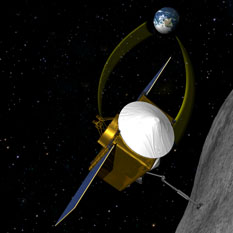
OSIRIS-REx mission
NASA / Goddard / University of Arizona
Contest extended to December 31, 2012!
OSIRIS-REx is going to fly to an asteroid and bring back some pieces. Right now, the asteroid's name is 1999 RQ36, but we think students can do better!  The Planetary Society, MIT's Lincoln Laboratory, and the University of Arizona are asking students around the world to suggest better names for the asteroid.
Enter by December 2, 2012 December 31, 2012to have a chance to name a piece of the solar system!
The contest is open to kids under the age of 18.  To enter, parents or teachers must fill out an online entry form with the proposed name and a short explanation of why that name is a good choice. 
Asteroids can't be named just anything, of course.  The International Astronomical Union governs the naming of big and small objects in the solar system, and they have guidelines on how to name near-Earth objects like 1999 RQ36.

Time-Lapsed Animation of a Mercury Day

Parts of Prokofiev crater (center) and Kandinsky crater (upper left side of Prokofiev) stay in darkness, making it possible for ice to persist on the surface. This time-lapsed animation represents nearly a full Mercury day. The illumination is derived from information provided by the Mercury Laser Altimeter.

Hubble Spots a Peculiar Compact Blue Dwarf Galaxy


The NASA/ESA Hubble Space Telescope captured an impressive image of the irregular galaxy NGC 5253.

Answer to Question 141


A141: A globular cluster is a spherical collection of stars that orbits a galactic core as a satellite. Globular clusters are very tightly bound by gravity, which gives them their spherical shapes and relatively high stellar densities toward their centers. The name of this category of star cluster is derived from the Latin globulus—a small sphere. A globular cluster is sometimes known more simply as a globular.
Globular clusters, which are found in the halo of a galaxy, contain considerably more stars and are much older than the less dense galactic, or open clusters, which are found in the disk. Globular clusters are fairly common; there are about 150 to 158 currently known globular clusters in the Milky Way, with perhaps 10 to 20 more still undiscovered Large galaxies can have more:Andromeda, for instance, may have as many as 500. Some giant elliptical galaxies, particularly those at the centers of galaxy clusters, such as M87,have as many as 13,000 globular clusters. These globular clusters orbit the galaxy out to large radii, 40 kiloparsecs (approximately 131,000 light-years) or more.

Source: Wikipedia

Friday, November 30, 2012

Question 141: 30 November 2012 (Week 48)

Q141: What is a Globular cluster?

Answer to Question 140

A140: The Galactic Center is the rotational center of the Milky Way galaxy. It is located at a distance of 8.33±0.35 kpc (~27,000±1,000 ly) from the Earth in the direction of the constellations Sagittarius,Ophiuchus, and Scorpius where the Milky Way appears brightest. There is strong evidence that supports the existence of asupermassive black hole at the Galactic Center of the Milky Way.


The Galactic Centre as seen by one of the 2MASS infrared telescopes, is located in the bright upper left portion of the image.

Source: wikipedia

A Multi-Wavelength View of Radio Galaxy Hercules A


Spectacular jets powered by the gravitational energy of a super massive black hole in the core of the elliptical galaxy Hercules A illustrate the combined imaging power of two of astronomy's cutting-edge tools, the Hubble Space Telescope's Wide Field Camera 3, and the recently upgraded Karl G. Jansky Very Large Array (VLA) radio telescope in New Mexico. Credit: NASA, ESA, S. Baum and C. O'Dea (RIT), R. Perley and W. Cotton (NRAO/AUI/NSF), and the Hubble Heritage Team (STScI/AURA)

Water Ice on Mercury: How It Stays Frozen (Infographic)

Learn about how billions of tons of water ice stays frozen at the north pole of the hottest planet, Mercury, in this SPACE.com infographic.
Source SPACE.com: All about our solar system, outer space and exploration

Water-Ice On Mercury - How It Was Found | Video


 It has been estimated that there may be up to 1 trillion metric tons of water ice on Mercury. Scientist David Lawerence explains how NASA's MESENGER mission's neutron spectroscopy data contributed to the find.
Credit: NASA. SPACE.com

A Mosaic of MESSENGER Images of Mercury's North Polar Region


Tradar image of Mercury's north polar region from Image 2.1 is shown superposed on a mosaic of MESSENGER images of the same area. All of the larger polar deposits are located on the floors or walls of impact craters. Deposits farther from the pole are seen to be concentrated on the north-facing sides of craters. Updated from N. L. Chabot et al., Journal of Geophysical Research, 117, doi: 10.1029/2012JE004172 (2012). 

Image Credit: NASA/Johns Hopkins University Applied Physics Laboratory/Carnegie Institution of Washington/National Astronomy and Ionosphere Center, Arecibo Observatory